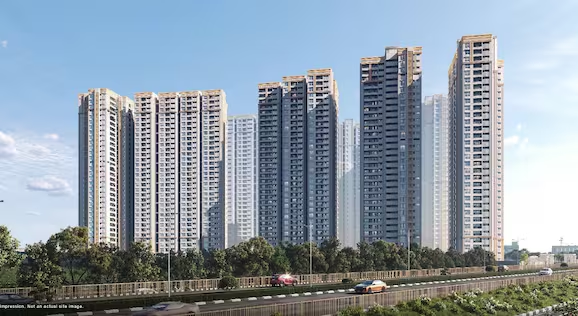
The Hyderabad real estate market has done something rare over the past decade — it has sustained appreciation across multiple economic cycles without the speculative volatility that damaged markets like Mumbai and NCR. According to Knight Frank India’s 2024 annual report, Hyderabad crossed ₹40,000 crore in residential transactions last year — the city’s strongest single-year volume on record.
That performance isn’t accidental. It reflects a genuine economic foundation: 50+ Fortune 500 company campuses, India’s largest and fastest-growing Global Capability Centre ecosystem, a metro network expanding by an approved 116.2km under Phase 2, and an Outer Ring Road that has systematically unlocked peripheral land value across every compass direction from the city core.
Developers who have read that foundation correctly — companies like SJS Avenues LLP, operating under Kannatt Group and led by Kannatt Surendran — have consistently entered growth corridors before market pricing reflected their full infrastructure value. That sequencing is where Hyderabad’s real investment story lives.
The Hyderabad real estate market is driven by employment fundamentals — not sentiment cycles. That’s the single most important distinction between Hyderabad and most other Indian property markets.
GCC (Global Capability Centre) expansion is the headline driver. As of 2024, Hyderabad hosts over 200 GCC campuses — second only to Bengaluru nationally — employing hundreds of thousands of high-income technology professionals who represent the core residential demand base for premium housing. Per JLL India’s 2024 GCC report, Hyderabad absorbed 8.2 million sq.ft of GCC office space in 2024 alone.
Metro Phase 2’s approved 116.2km expansion is the secondary driver. New corridors along the western and southern ORR belt are creating residential demand before physical connectivity is complete — which is historically when the strongest appreciation occurs.

| Indicator | Data Point | Source |
|---|---|---|
| Annual transaction volume | ₹40,000 crore | Knight Frank India 2024 |
| GCC office absorption | 8.2 million sq.ft | JLL India 2024 |
| Metro Phase 2 expansion | 116.2 km approved | Telangana Government |
| NRI remittances into Hyderabad | ₹12,000 crore FY2024 | CREDAI Hyderabad |
| Average possession delay | 14 months industry-wide | RBI 2024 |
| ORR plotted development appreciation | 18–22% annually | ANAROCK 2025 |
Understanding the Hyderabad real estate market means understanding which corridors are performing, which are approaching peak pricing, and which still offer genuine entry headroom for 2025–2026 investors.
Western ORR Belt — Mokila and Kollur
Mokila moved from ₹18,000–₹22,000/sq.yd in 2021 to ₹35,000–₹55,000/sq.yd by early 2025, per ANAROCK’s tracker — a 60–80% appreciation run driven by Financial District spillover. Kollur runs at ₹30,000–₹48,000/sq.yd. Both corridors entered mainstream buyer awareness after serious investors and developers had already established positions.
Southern ORR Corridors — Shadnagar and Shamshabad
Shadnagar (₹8,000–₹15,000/sq.yd) represents Hyderabad’s strongest remaining value-entry corridor — industrial cluster expansion, ORR access, and improving employment connectivity creating a demand trajectory that early investors are currently positioned ahead of. Shamshabad (₹20,000–₹35,000/sq.yd) benefits from airport proximity and logistics sector growth.
Eastern Employment Corridors — Adibatla and Tukkuguda
Adibatla (₹18,000–₹28,000/sq.yd) has emerged as a genuine residential demand zone driven by aerospace, defence, and IT cluster growth — a different demand driver from the western corridors, providing portfolio diversification value for investors thinking across the broader Hyderabad real estate market.

SJS Avenues LLP, Kannatt Group’s real estate development arm, approaches Hyderabad’s market through a methodology that Kannatt Surendran developed over two decades of direct involvement in the city’s property sector — reading infrastructure allocation data before that data reaches general market awareness.
Government budget lines for road widening, metro corridor notifications, SEZ approvals, and industrial cluster designations show where values are moving 3–5 years before mainstream buyer awareness. Shadnagar’s emergence as an investment zone, the Financial District demand pushing into Mokila and Kollur, Shamshabad’s logistics growth — each of these was identifiable from infrastructure filings before property supplements covered them.
“The Hyderabad real estate market rewards investors who read infrastructure data — not those who read property portals,” is a principle that shapes every SJS Avenues LLP site selection decision. It’s also why the company’s corridor entries have consistently preceded appreciation rather than followed it.
No analysis of the Hyderabad real estate market is complete without understanding NRI demand — a buyer segment that has grown consistently and is reshaping which corridors developers prioritise.
Per CREDAI Hyderabad, NRI remittances into the city’s property market crossed ₹12,000 crore in FY2024. Hyderabad ranks among India’s top three NRI investment destinations alongside Mumbai and Bangalore — driven by stable Telangana governance, transparent RERA frameworks, and strong IT employment that keeps the city familiar to returning professionals.
The Hyderabad real estate market operates under a regulatory framework that has significantly improved buyer protection since RERA’s 2017 implementation in Telangana.
Per RBI’s 2024 Household Finance Report, India’s average possession delay runs 14 months. In Hyderabad’s market, developers with consistent sub-six-month delay records are statistically exceptional — and worth identifying before capital is committed.
Three infrastructure movements will shape Hyderabad’s market through 2026:

The Hyderabad real estate market is driven by GCC expansion, Fortune 500 campus growth, and IT sector demand — crossing ₹40,000 crore in annual transactions per Knight Frank 2024.
Shadnagar ₹8,000–₹15,000/sq.yd leads value entry, followed by Adibatla and Shamshabad with confirmed infrastructure pipelines per ANAROCK 2025.
Metro Phase 2’s 116.2 km expansion creates residential demand along new corridors before physical connectivity is complete — historically the strongest appreciation window.
NRI remittances crossed ₹12,000 crore in FY2024 — placing Hyderabad among India’s top three NRI investment markets per CREDAI Hyderabad.
The Hyderabad real estate market has proven consistently that appreciation follows infrastructure allocation — not sentiment, not headlines, not launch-weekend buzz. Investors who understand that principle, and who partner with developers and consultants who apply it systematically, have historically captured returns that passive market followers missed entirely.

Kannatt Surendran is the founder of Kannatts Group and Managing Director of SJS Avenues LLP — a Hyderabad-based real estate development company specialising in HMDA-approved plotted developments and gated communities across Hyderabad’s high-growth corridors.
With 15+ years of experience in real estate, property management, and business development across Hyderabad, Mumbai, Delhi, Chennai, and Bengaluru, Mr. Surendran has overseen more than 5 million sq ft of real estate transactions through Kannatts Group companies including Bounty Property Management and Keyprop Property Management.
He is an active member of:
– National Association of Realtors India (NAR)
– Hyderabad Realtors Association (HRA)
– Federation of Telangana Chambers of Commerce & Industry (FTCCI)
– Indo-American Chamber of Commerce (IACC)
– Indo-Australian Chamber of Commerce
He serves as Global Vice President of the Pravasi World Malayalee Council (PWMC) and Chairman of the Telangana All In Malayalee Association. In 2024, he received the Business Excellence Award from the World Malayalee Council (WMC) at their Global Business Conclave in London.