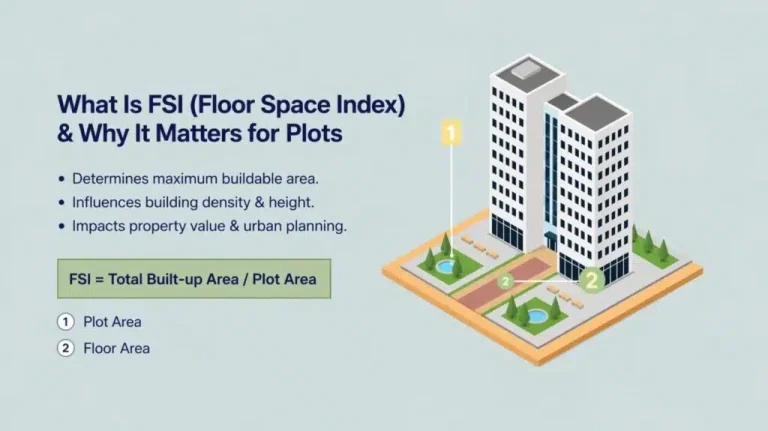
If you plan to buy land, build a house or invest in property, you may ask, what is FSI in real estate? FSI stands for Floor Space Index. It shows the relationship between a plot’s total area and the total floor area counted under local building rules.
Understanding what is FSI in real estate can help you estimate how much space may be built on a plot. It also helps you compare land, understand development plans and ask better questions before buying property.
However, FSI is not the only rule that controls a building. Local regulations, road width, setbacks, parking and height limits can also affect the final design Explore Kannatts.
FSI, or Floor Space Index, is the ratio of a building’s counted floor area to the total area of the plot.
For example, imagine you own a plot measuring 1,000 square feet. If the permitted FSI is 2, the calculation gives a potential counted floor area of 2,000 square feet.
This does not mean you can build any design you want. Other building rules may limit the size, height and layout of the structure.
The term Floor Area Ratio (FAR) is also used in many places for a similar measurement. The exact calculation can vary under local rules.
The FSI formula is simple:
FSI = Total counted floor area ÷ Total plot area
To estimate the potential floor area, use this formula:
Potential counted floor area = Plot area × Permitted FSI
For example, suppose your plot measures 600 square metres and the permitted FSI is 1.5.
This example shows how to calculate FSI. It does not guarantee that the entire 900 square metres will be approved for construction. The final plan must follow the rules that apply to the property.
Knowing what is FSI in real estate helps buyers, landowners and developers understand the possible use of a plot.
A higher permitted FSI may allow more counted floor area on the same plot. This can give a developer more options when planning apartments, offices or other buildings.
However, height restrictions, setbacks and other rules can still limit the final design.
Two plots of the same size may have different development potential. A plot that allows more floor area may attract interest from developers.
Still, FSI alone does not determine land value. Location, road access, demand, ownership documents and construction costs also matter.
Architects and developers use FSI when preparing early building plans. It helps them estimate potential floor area before moving to detailed designs and approvals.
They must also check the site conditions and local regulations before confirming what can be built.
More floor area may allow a project to include more homes or usable space. It can also increase construction expenses, professional fees and other costs.
Buyers should compare the full cost of a project rather than assuming that more floor area always means a better investment.
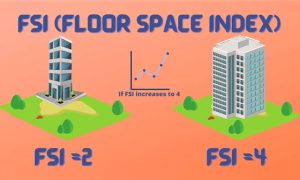
FSI helps estimate the total counted floor area allowed on a plot. That area may be spread across different floors, subject to the applicable rules.
For example, a building with 2,000 square feet of counted floor area could have two floors of 1,000 square feet each. Another design might use more floors with smaller floor areas.
The actual number of floors depends on building height limits, ground coverage, setbacks, parking and safety requirements.
This is why what is FSI in real estate should be considered alongside the other rules that control building design.
Plot area is the total area of the land. FSI is the ratio used to calculate the counted floor area that may be permitted on that land.
| Term | Meaning |
|---|---|
| Plot area | Total area of the land |
| FSI | Ratio of counted floor area to plot area |
| Floor area | Counted area across a building’s floors |
| Ground coverage | Portion of the plot covered by the building at ground level |
| Building height | Vertical height allowed under applicable rules |
A plot may have enough permitted floor area for a large building but still face limits on height, ground coverage or setbacks.
In Hyderabad, the permitted building area depends on the rules that apply to the property and its location. You should not assume that every plot has the same permitted FSI.
Factors such as road width, plot size, building use, height and other planning conditions may affect the development potential.
Before buying land or starting construction, ask a qualified architect or planning professional to review the site. Confirm the permitted floor area, setbacks, height limits and required approvals with the relevant authority.
Understanding what is FSI in real estate is especially useful when comparing plots for a home, apartment building or commercial project. A seller’s estimate should never replace a review of the actual planning conditions.
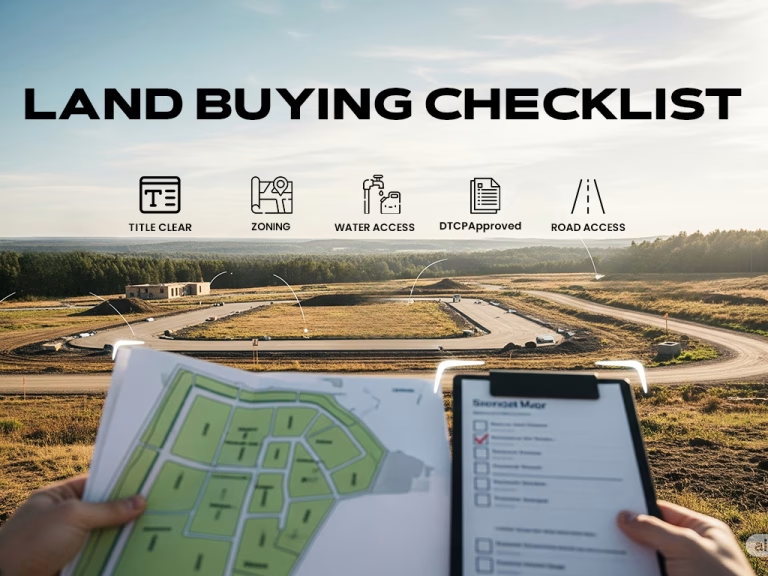
FSI is only one part of property due diligence. Before making a purchase, review these points:
These checks help you understand whether the land suits your plans and reduce the risk of unexpected costs.
Yes. FSI can influence a property’s development potential, but it does not guarantee a profit.
A plot with a higher permitted floor area may offer more design options. However, the final result depends on the purchase price, construction costs, local demand and approval conditions.
Before investing, compare similar plots in the same area. Check their permitted uses, access, development limits and likely expenses. If you plan to work with a developer, make sure the proposed responsibilities and payment terms are clearly documented Looking for Expert Real Estate Advice?
FSI is the ratio between a building’s counted floor area and the total plot area. It helps determine how much floor space may be allowed on a plot under local building regulations.
Not always. Higher FSI may allow more floor area, but it does not guarantee higher returns. Purchase price, construction costs, location, demand and approval conditions also affect property value.
FSI stands for Floor Space Index, while FAR stands for Floor Area Ratio. Both generally describe the ratio of counted floor area to plot area, although the exact calculation may vary under local rules.
An EOI records interest and may not involve payment. A booking amount is generally linked to a more specific step in selecting or reserving a property. The legal effect of either payment depends on the documents and applicable law.
Understanding what is FSI in real estate can help you assess land and plan a building more carefully. FSI gives you a useful way to estimate potential floor area, but it does not determine the complete building plan.
Before investing in Hyderabad property, check the applicable rules, review the land documents and seek a professional assessment of the site’s development potential. These steps can help you compare properties and make a more informed decision

Kannatt Surendran is the founder of Kannatts Group and Managing Director of SJS Avenues LLP — a Hyderabad-based real estate development company specialising in HMDA-approved plotted developments and gated communities across Hyderabad’s high-growth corridors.
With 15+ years of experience in real estate, property management, and business development across Hyderabad, Mumbai, Delhi, Chennai, and Bengaluru, Mr. Surendran has overseen more than 5 million sq ft of real estate transactions through Kannatts Group companies including Bounty Property Management and Keyprop Property Management.
He is an active member of:
– National Association of Realtors India (NAR)
– Hyderabad Realtors Association (HRA)
– Federation of Telangana Chambers of Commerce & Industry (FTCCI)
– Indo-American Chamber of Commerce (IACC)
– Indo-Australian Chamber of Commerce
He serves as Global Vice President of the Pravasi World Malayalee Council (PWMC) and Chairman of the Telangana All In Malayalee Association. In 2024, he received the Business Excellence Award from the World Malayalee Council (WMC) at their Global Business Conclave in London.